
If you live in Sweden, you know ICA. They aren’t just a grocery chain; they are an institution. Specifically, ICA MAXI represents the heavy hitters of the group—the hypermarkets where you go to buy everything from tonight’s dinner to a new lawnmower. With 89 massive locations across the country, they are the undeniable giants of the sector.
However, being the biggest player on the field comes with a heavy responsibility. ICA MAXI approached us at Blink, a premier retail design agency in Sweden, because they realized that "big" doesn’t always mean "better" in the eyes of the modern consumer. They were facing an identity crisis common among large-format retailers: how do you maintain the efficiency of a hypermarket while fostering the intimacy of a local grocer? They didn't just want a facelift; they wanted a future-proof retail concept that placed them at the forefront of sustainability and customer experience. They came to us because as Scandinavian retail design experts, we know how to balance functional volume with human emotion.

The primary issue with the traditional hypermarket model is the "hangar effect." Walking into a 10,000-square-meter facility often feels industrial, cold, and transactional. ICA MAXI was suffering from this legacy perception. The sheer scale of the stores, while great for inventory, was becoming a barrier to emotional connection.
Furthermore, the modern shopper has evolved. They are hyper-aware of their carbon footprint. A brightly lit, energy-guzzling warehouse filled with plastic-wrapped goods no longer aligns with the values of the conscious consumer. ICA MAXI needed to solve a complex equation: How do we humanize a massive space? How do we prove that a hypermarket can be a champion of sustainability rather than a contributor to waste? And crucially, how do we stop the "grab-and-go" mentality and turn the store into a destination where families actually want to spend time?
As a European retail design studio that thrives on complex spatial problems, we saw this as an opportunity to completely rewrite the rulebook on retail concept design in the Nordics.
Before we sketched a single floor plan, our team hit the ground. We conducted extensive store audits and customer interviews to understand the friction points in the current layout. As store interior design specialists, we know that data tells you what is happening, but observation tells you why.

Our research revealed a significant disconnect. Shoppers wanted to buy sustainable products, but they felt the store environment itself contradicted those choices. If a customer buys organic apples in a sterile, fluorescent-lit aisle, the emotional reward is diminished. We discovered that for sustainability to be believable, it must be visible in the architecture, not just the packaging.
User journeys showed that customers often felt overwhelmed by the "racetrack" layout of a hypermarket. It felt like a chore—a marathon run to get bread and milk. We realized we needed to break the journey into "chapters," creating moments of pause and discovery rather than a relentless sprint to the checkout.
We observed that in the hypermarket sector, the kids often dictate the duration of the visit. If the children are bored or fussy, the shopping trip is cut short, and basket size decreases. The insight was clear: if we build a store that children enjoy, we buy the parents time to shop at leisure.
Our strategy was rooted in "Humanizing the Scale." We aimed to deconstruct the monolithic hypermarket into a series of intimate, purpose-driven zones. Unlike competitors who focus solely on shelving efficiency, our approach as Scandinavian retail design experts was to focus on "atmospheric zoning."
We decided to flip the script on the standard layout. Instead of greeting customers with dry goods or promotions, we would immerse them immediately in a sensory experience. The strategy centered on three pillars: Radical Transparency (showing where food comes from), Circular Economy Integration (making waste reduction visible), and The Living Room Effect (adding warmth and comfort).
We utilized our background as a leading retail design agency in Sweden to advocate for a "phygital" approach—blending physical tactility with digital convenience—ensuring that efficiency didn't come at the cost of experience.


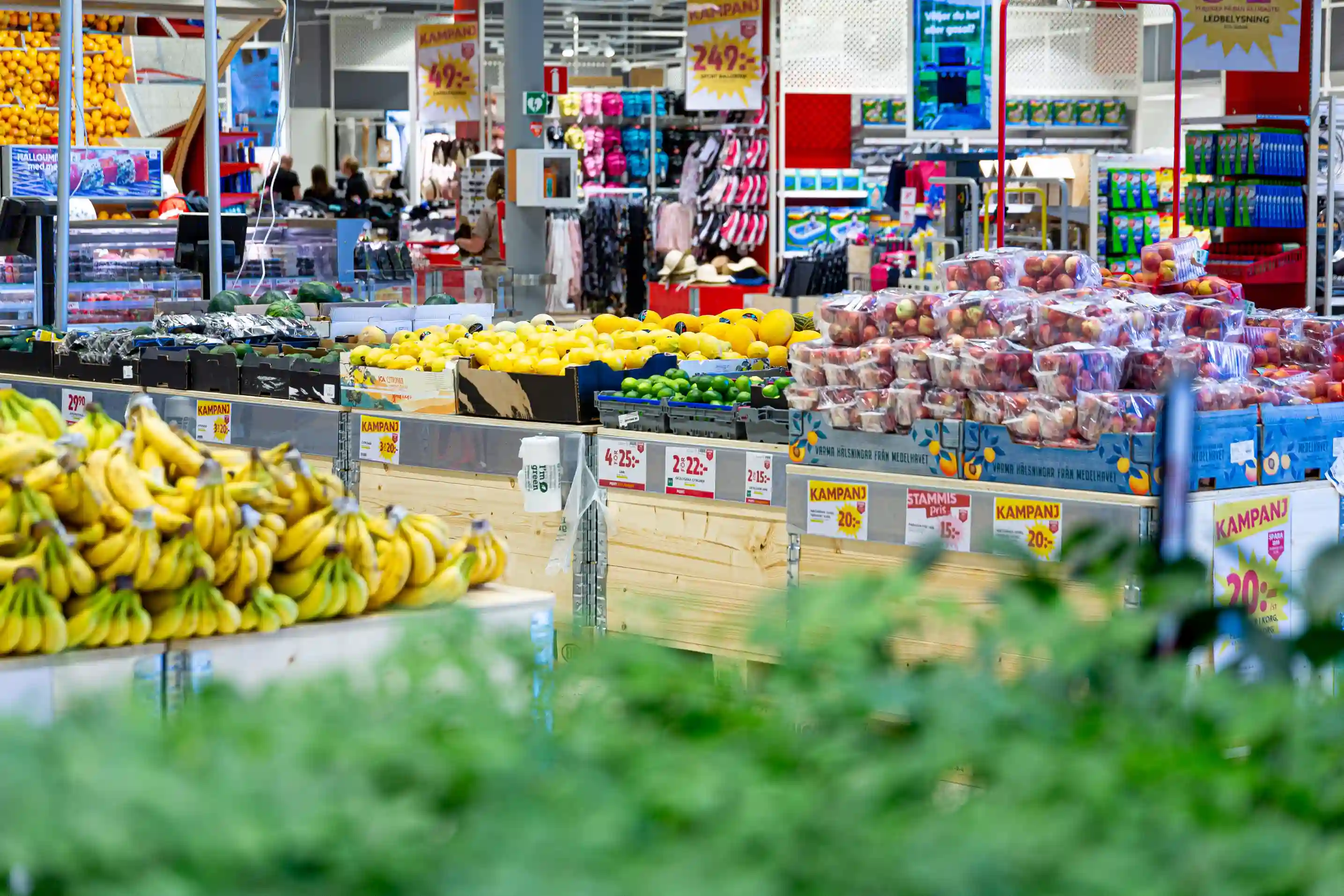
We completely reimagined the fresh food section. Drawing inspiration from traditional Swedish "Saluhall" (market halls), we broke down long, parallel aisles into islands and clusters. This forces the customer to slow down and meander, mimicking the discovery process of a farmers' market. The visual merchandising here is abundant and colorful, celebrating the "perfectly imperfect" nature of organic produce.
To combat the industrial feel, we overhauled the material palette. We stripped away glossy plastics and cold metals, replacing them with natural woods, recycled composites, and warm, textured finishes. Lighting played a crucial role; we moved away from uniform high-bay lighting to focused, warm-temperature spotlights that highlight the product, not the floor. This creates a cozy, theatrical atmosphere that is rare in hypermarket retail design.
As store interior design specialists, we believe sustainability must be functional. We designed dedicated zones for "imperfect" produce—vegetables that look funny but taste great—offering them at a discount to reduce waste. Furthermore, we integrated a system where near-expiry food is up-cycled to an in-store kitchen or partnered local restaurants. We made these "waste-saving stations" prominent design features, not hidden back-of-house operations.
We created a "friendly family store" atmosphere. This involved widening aisles for stroller maneuverability and integrating play zones within the shopping flow, not just at the entrance. We added comfortable seating areas—rest zones—where families can take a break. It sounds simple, but in the world of retail concept design in the Nordics, allowing a customer to sit down without buying a coffee is revolutionary.
To ensure the "BIG" shopping trip remained smooth, we integrated seamless tech. We designed clear, intuitive wayfinding for "Click and Collect" lockers and "Shop & Go" scanners. The design facilitates a hybrid journey where a customer can research a product on their phone, find it instantly via digital signage, and check out without a queue.
Rolling out a total transformation across 89 locations is a logistical beast. As a European retail design studio, we are used to scale, but this project had unique hurdles. The main challenge was implementing these drastic physical changes—like ripping out flooring and installing new energy-efficient cooling systems—while keeping the stores operational.
We worked closely with local contractors to source materials that were not only sustainable but locally available to each specific store region, reducing the carbon footprint of the renovation itself. We also had to balance the massive brand identity of ICA with the need for "localness." We solved this by designing flexible signage frames that allowed individual store managers to highlight local farmers and suppliers, giving each massive hypermarket a unique, community-centric flavor.

The stores with the new concept have seen a significant uptick in daily visits.
Customers are spending longer in the store, directly correlating to increased basket size. The integrated "rescue" stations and smart inventory displays have measurably lowered food waste percentages per location.
The feedback from the community has been overwhelming. Customers report feeling less stressed during their weekly shop. The perception of ICA MAXI has shifted from a "necessary chore" to a "destination of choice". By proving that a hypermarket can be warm, sustainable, and locally grounded, we have strengthened customer loyalty in an era where brand switching is rampant.
richard@blinkthedesignagency.com
+46 73 545 5018
Blink is a leading retail design agency based in Sweden, specializing in retail concept development, store experience design, and omnichannel integration across the Nordics and Europe. We transform brands into physical destinations that drive both emotional connection and commercial performance.
.avif)